You noticed 28 in a Bible reading plan, a chapter count, or maybe a verse reference like Romans 8:28, and something about it stayed with you. This page looks at 28 specifically through the lens of Scripture and biblical numerology — not general angel-number spirituality, but what the Bible’s own patterns of numbers can (and honestly cannot) tell us about 28.
📖 What Does 28 Mean in the Bible?
Unlike numbers such as 7, 12, or 40 — which Scripture uses again and again in ways that are impossible to miss — 28 does not appear as a headline symbol anywhere in the Bible. There is no verse that announces “28 means such-and-such,” the way Genesis leans on 7 for completion or Israel’s wilderness years lean on 40 for testing.
That does not mean 28 is meaningless to biblical numerology. It means 28 has to be understood the way most numbers in Scripture actually work: as a compound number, built from smaller numbers that do carry consistent symbolic weight. 28 is 4 × 7, and it is also 2 and 8 read as digits. Both of those angles give serious, text-grounded material to work with — and that is the approach this page takes, rather than treating 28 as if it had its own standalone verse.
If you are looking for the broader spiritual or angel-number reading of 28 — the interpretation that draws on numerology traditions outside Scripture — our general guide to 28 angel number meaning covers that ground. This page stays inside the biblical frame.
🔢 The Numbers 2 and 8 in Scripture
Biblical numerology is not fortune-telling. It is a long-standing tradition of biblical scholarship — going back to early rabbinic and Christian commentators — that notices numbers recurring in patterned ways throughout Scripture and asks what those patterns might be pointing toward. Two of the building blocks of 28 have well-documented symbolic threads.
The Number 2: Witness, Division, Covenant
Two shows up in Scripture wherever something needs to be established, confirmed, or held in relationship. Deuteronomy 19:15 sets the legal principle directly: “A single witness shall not suffice against a person for any crime or for any wrong… only on the evidence of two witnesses or of three witnesses shall a charge be established.” Jesus applies the same pattern in Luke 10:1, sending his disciples out two by two. Two tablets of the covenant law came down from Sinai. Two by two, the animals entered Noah’s ark.
Numerologists working within a biblical framework generally read 2 as the number of testimony, agreement, and covenant relationship — something that only becomes valid or complete when it is confirmed by a second party. It can also carry a shadow meaning of division or opposition, since separating one thing into two is itself a kind of splitting (the second day of creation in Genesis 1 is notably the only day not called “good,” a detail some biblical numerologists connect to this dual nature of 2).
The Number 8: New Beginnings and Resurrection
Eight is one of the more consistently symbolic numbers in biblical numerology, and its meaning is well anchored in the text. Circumcision, the sign of God’s covenant with Abraham, was commanded on the eighth day of a male infant’s life (Genesis 17:12, Leviticus 12:3) — a new life marked and set apart just after the completion of a full week. Eight people survived the flood in Noah’s ark (1 Peter 3:20), stepping out into a re-created world. And in the New Testament, the resurrection of Jesus is traditionally understood as having occurred on “the first day of the week” following the Sabbath — the eighth day in a seven-day cycle, a day standing outside and beyond the completed week.
Because of this pattern, 8 has long been associated in Christian numerological tradition with resurrection, regeneration, and new beginnings that follow the completion of a cycle. Early church writers sometimes referred to Sunday as “the eighth day” for exactly this reason — not just the start of a new week, but a symbol of life after the old order has run its course. This is not a minor footnote in church history either: early Christian baptisteries were frequently built as octagons, an architectural choice historians directly connect to this eighth-day symbolism — the baptized believer entering, in a physical building, into the shape of resurrection and new life. Augustine and other early theologians wrote about the number 8 in exactly these terms, treating it as the number that stands outside and beyond the completed week of ordinary time.
📜 Where 28 Appears in Scripture
28 itself is not a symbolic centerpiece anywhere in the Bible, but the number does turn up in a few structural places worth naming honestly, without overstating them.
The tabernacle’s construction in Exodus 26 specifies curtains of precise, repeated measurements — cubits counted out in careful multiples as part of God’s instructions for a dwelling place set apart for worship. Numbers 28–29 form a distinct block of the Torah devoted entirely to the calendar of required offerings, laying out, feast by feast, exactly what was to be sacrificed and when — a chapter literally numbered 28 that is itself about sacred order and timing, though that is a numbering-system coincidence rather than a claim that “28” was intentionally symbolic to the original audience.
Some biblical numerologists also point to the priestly and Levitical rotations described in 1 Chronicles 24, where the priesthood was organized into 24 courses serving in careful sequence — a structure of ordered, cyclical service that later commentators have drawn loose comparisons to when discussing numbers built from 4 and 7, though this connection is closer to homiletical reflection than settled scholarship, and it is worth being upfront about that distinction.
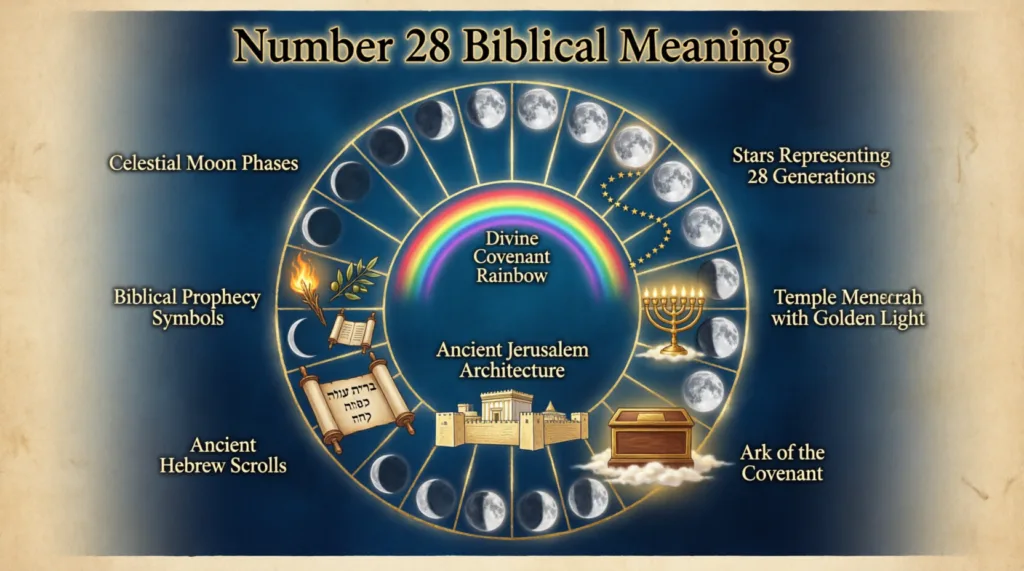
The most concrete and least disputed appearance of 28-as-a-pattern in Scripture is calendrical rather than a single verse: the Hebrew lunar month runs close to 28 days, and ancient Hebrew reckoning of sacred time was built around lunar cycles of roughly this length. That everyday rhythm — a full cycle of the moon returning to its starting point — is where the “completion returning to new beginning” reading of 28 has its most solid grounding, more solid than any single proof-text.
Ecclesiastes 3:1 captures the spirit of this kind of cyclical timing well: “For everything there is a season, and a time for every matter under heaven.” A 28-day cycle — lunar, sacred, or otherwise — fits that idea of ordered seasons closing so that new ones can begin.
It is worth pausing on why the lunar connection matters more than it might seem. The Hebrew calendar was fundamentally lunar, with each new month beginning at the sighting of the new moon (Numbers 10:10, Psalm 81:3). Passover, Pentecost, and the Feast of Tabernacles were all set by this lunar-based sacred calendar. A month running close to 28 days was therefore not an abstract idea to the biblical writers and their original audience — it was the literal rhythm by which festivals were dated, offerings were scheduled, and sacred time was structured. That everyday, structural presence is a more solid foundation for taking 28 seriously than any single symbolic proof-text could be, precisely because it was lived rather than merely written.
✝️ 28 and the Theme of New Beginnings
The strongest and most defensible symbolic reading of 28 in biblical numerology comes from its arithmetic: 28 = 4 × 7.
Four is widely associated in Scripture with the created, physical world — four directions, four winds, four rivers flowing out of Eden in Genesis 2:10, four living creatures around God’s throne in Revelation 4. It represents the earth and its order, creation in its fullness. Seven, meanwhile, is the Bible’s clearest number of completion and divine rest — six days of creation followed by the seventh day of rest in Genesis 2:2, seven being woven throughout Revelation’s structure of seals, trumpets, and bowls.
Read together, 4 × 7 gives 28 a coherent symbolic identity: four complete cycles of divine completion, or the created world (4) brought fully under the order of divine rest and completeness (7). It is a number built from creation and Sabbath rest multiplied into each other — which lines up naturally with the lunar month, itself a repeating cycle where the created world (the moon’s physical orbit) moves through a complete rhythm before beginning again.
Layer the digit-based reading of 2 and 8 on top of that, and the picture holds together rather than fighting itself: 2 as covenant and confirmation, 8 as resurrection and new beginning, arriving together at the end of a 4×7 cycle of completed order. Romans 8:28 — “And we know that in all things God works for the good of those who love him” — is not a numerology proof-text, but many believers find that its chapter-and-verse address happens to land on a number whose deeper structure already points toward good arriving after a completed, difficult season. That is a devotional resonance worth naming, not a scholarly claim about the verse itself.
This is also a useful moment to be honest about the limits of the method. Multiplying two symbolically loaded numbers together and reading meaning into the product is a well-established practice within biblical numerology, but it is an interpretive tool, not a mathematical proof. The biblical writers were not composing a hidden code for later readers to decrypt with arithmetic — they were using numbers the way ancient literature often does, as recurring motifs that reinforce a theological point. 4 × 7 = 28 is a genuinely coherent way to think about the number, built from patterns Scripture does support, but it remains a synthesis rather than something the text states outright. Held with that honesty, it is still a rich and worthwhile way to think about what 28 can represent inside a biblical worldview: a full, earthly cycle brought to rest and completion, poised at the edge of something new.
🕊️ How Biblical Numerology Differs From Angel Number Spirituality
It is worth being clear about what makes this page’s approach different from a typical “angel number 28” interpretation, because the two traditions get blended together online more often than they should be.
Angel number spirituality is a modern framework, popularized largely through 20th- and 21st-century numerology and New Age writing, which treats repeating numbers you notice in daily life — on a clock, a receipt, a license plate — as personal messages from spirit guides, angels, or the universe. It draws partly on Pythagorean numerology (the idea that numbers carry vibrational energy) and partly on contemporary spiritual practice, and it is not rooted in Scripture at all.
Biblical numerology is older and works differently. It studies how numbers function as literary and theological patterns within the Bible’s own text — how often 7 or 12 or 40 recur, what those patterns seem to communicate about God’s character and order, and how later numbers can sometimes be understood by breaking them into components that Scripture does treat consistently. It is not about receiving a personal sign when you glance at a clock. It is about reading a very old text carefully and noticing how it uses numbers as a kind of theological shorthand.
Both traditions can be meaningful to different readers, and plenty of people hold an interest in both without much tension. But they are genuinely separate frameworks, and this page is deliberately staying inside the biblical one. If the personal-sign, seeing-28-everywhere angle is what brought you here, our general guide to 28 angel number meaning is the better fit, and if you are specifically wondering what 28 might mean for a relationship, what 28 means in love and relationships covers that ground in full.
🙏 What This Might Mean If You Keep Encountering 28
If you keep running into 28 in a specifically biblical context — a chapter number that keeps coming up in your reading plan, a verse reference, a date that lines up with Romans 8:28 — the most faithful response, from within this tradition, is not to treat it as a coded message but as an invitation to slow down with the text itself.
A few grounded ways to engage with that, staying inside a biblical frame rather than a general spiritual one:
- Read Romans 8:28 in its full context — the surrounding verses in Romans 8 are about the Spirit interceding in weakness and nothing being able to separate believers from God’s love. The single verse lands differently once you read the paragraph it sits inside.
- Sit with the idea of the eighth day. If 8’s resurrection symbolism resonates with where you are, ask honestly what in your life feels like it is ending a cycle and what a “new beginning” would actually require of you, not just wish for.
- Bring it to prayer rather than to speculation. Scripture’s numbers are meant to deepen reading and worship, not to function as a private code to be decoded. If 28 keeps catching your attention, let that be a nudge toward opening the text, not toward searching for a hidden personal message.
- Hold the interpretation loosely. Even careful biblical numerology involves reading patterns, not decoding certainties — the honest scholarly position is that 2 and 8 carry consistent symbolic threads in Scripture, while 28 itself is an inference built from them, not a number the Bible directly names.
That kind of discernment — reading carefully, holding conclusions with appropriate humility, and letting a text you trust shape your reflection — is really what biblical numerology asks of a reader, more than any specific meaning attached to any specific number.
It also helps to remember that Scripture treats waiting itself as meaningful. The Israelites did not simply arrive at the Promised Land; they moved through decades of wilderness first. The disciples did not receive the Spirit the moment Jesus rose; they waited through the eighth day and beyond, into Pentecost. If 28’s structure — four complete cycles brought to a rest that opens into something new — resonates with a season you are in, the most biblically consistent response is patience paired with attentiveness, not urgency. The pattern in Scripture is rarely instant transformation; it is faithfulness sustained through an ordinary, countable cycle of time until the new thing arrives on its own schedule rather than yours.
❓ Frequently Asked Questions
Does the number 28 appear directly in the Bible?
Not as a standalone symbolic number the way 7, 12, or 40 do. 28 shows up structurally — in the measurements of the tabernacle curtains in Exodus 26, as the chapter number covering Israel’s offering calendar in Numbers 28, and in the roughly 28-day length of the Hebrew lunar month — but Scripture never singles it out the way it singles out numbers like 7.
What does the number 8 mean in biblical numerology?
Eight is consistently associated with new beginnings and resurrection in biblical numerology, largely because circumcision occurred on the eighth day (Genesis 17:12) and Christ’s resurrection is understood as occurring on the “eighth day” beyond a completed seven-day week. It represents a fresh start that follows, rather than replaces, a finished cycle.
What does the number 2 mean in biblical numerology?
Two is generally read as the number of witness, testimony, and covenant confirmation — rooted in Deuteronomy 19:15’s requirement of two witnesses to establish a matter, and echoed in Jesus sending disciples out two by two in Luke 10:1. It can also carry a secondary sense of division, since splitting something into two parts is inherent to the number itself.
Is 28 considered a significant number in Scripture?
It is significant in a secondary, structural sense rather than as a headline symbolic number. Because 28 is 4 × 7 — creation multiplied by divine completion — and because it lines up with the lunar month’s natural rhythm, many biblical numerologists treat it as a meaningful compound number, even though the Bible never devotes a passage to explaining “28” the way it does with numbers like 12 or 40.
How is this different from the angel number interpretation of 28?
Angel number interpretations of 28 draw on modern numerology traditions and treat the number as a personal spiritual sign noticed in everyday life. Biblical numerology, covered here, instead studies how 2, 8, and their product 28 function as literary and theological patterns within Scripture itself. For the angel-number reading, see our general guide to 28 angel number meaning.
What does Romans 8:28 have to do with the number 28?
Nothing beyond a numerical coincidence in the chapter-and-verse address — the verse itself was not written with 28 as a symbolic device. Many readers nonetheless find it meaningful that a verse about God working good out of hardship happens to be numbered in a way that echoes 8’s resurrection symbolism, but that connection is devotional rather than textual.
Frequently Asked Questions
Does the number 28 appear directly in the Bible?▼
Not as a standalone symbolic number the way 7, 12, or 40 do. 28 shows up structurally in the tabernacle curtain measurements of Exodus 26, as the chapter covering Israel’s offering calendar in Numbers 28, and in the roughly 28-day length of the Hebrew lunar month, but Scripture never singles it out symbolically.
What does the number 8 mean in biblical numerology?▼
Eight is consistently associated with new beginnings and resurrection in biblical numerology, largely because circumcision occurred on the eighth day and Christ’s resurrection is understood as occurring on the eighth day beyond a completed seven-day week.
What does the number 2 mean in biblical numerology?▼
Two is read as the number of witness, testimony, and covenant confirmation, rooted in Deuteronomy 19:15’s requirement of two witnesses and echoed in Jesus sending disciples out two by two in Luke 10:1.
Is 28 considered a significant number in Scripture?▼
It is significant in a secondary, structural sense: 28 is 4 times 7, combining creation with divine completion, and it aligns with the lunar month’s natural rhythm, though the Bible never devotes a passage to explaining the number 28 directly.
How is this different from the angel number interpretation of 28?▼
Angel number interpretations treat 28 as a personal spiritual sign noticed in daily life, drawing on modern numerology traditions. Biblical numerology instead studies how 2, 8, and 28 function as literary and theological patterns within Scripture’s own text.
What does Romans 8:28 have to do with the number 28?▼
The connection is a numerical coincidence in the chapter-and-verse address rather than a textual device. Many readers find it meaningful that a verse about God working good out of hardship carries a number that echoes 8’s resurrection symbolism, but that link is devotional, not scholarly.

Ivan has a passion for numbers and patterns. He specializes in angel numbers and their spiritual meanings, helping readers uncover hidden guidance in everyday sequences.